




Building NWTD
Infrastructure being delivered as part of Stage 1 of the North West Transmission Developments includes 3 km of new and 126 km of upgraded transmission lines. It also includes upgrades to the Sheffield, Palmerston and Burnie substations, along with a new switching station at Heybridge to support the Marinus Link converter station.
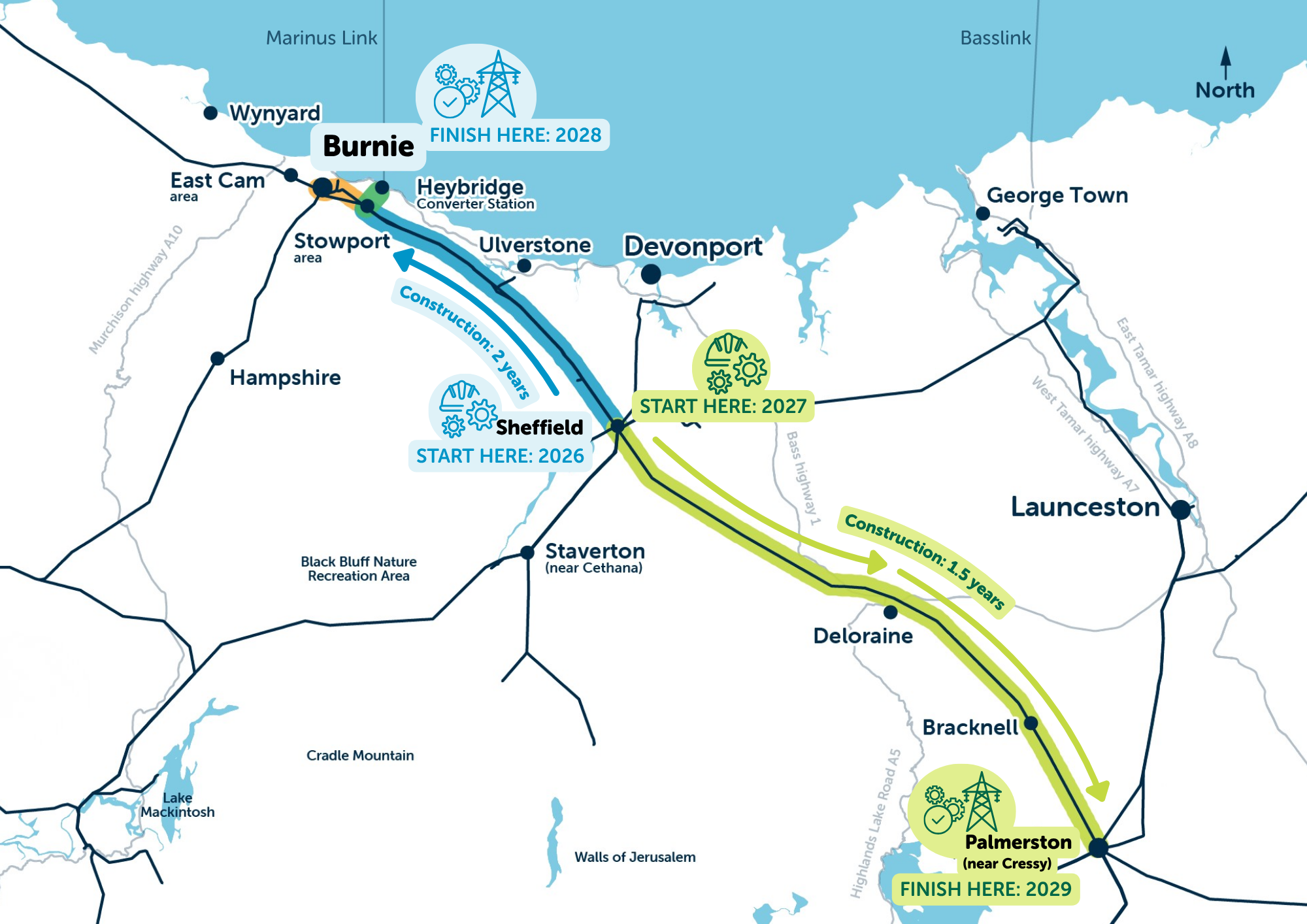
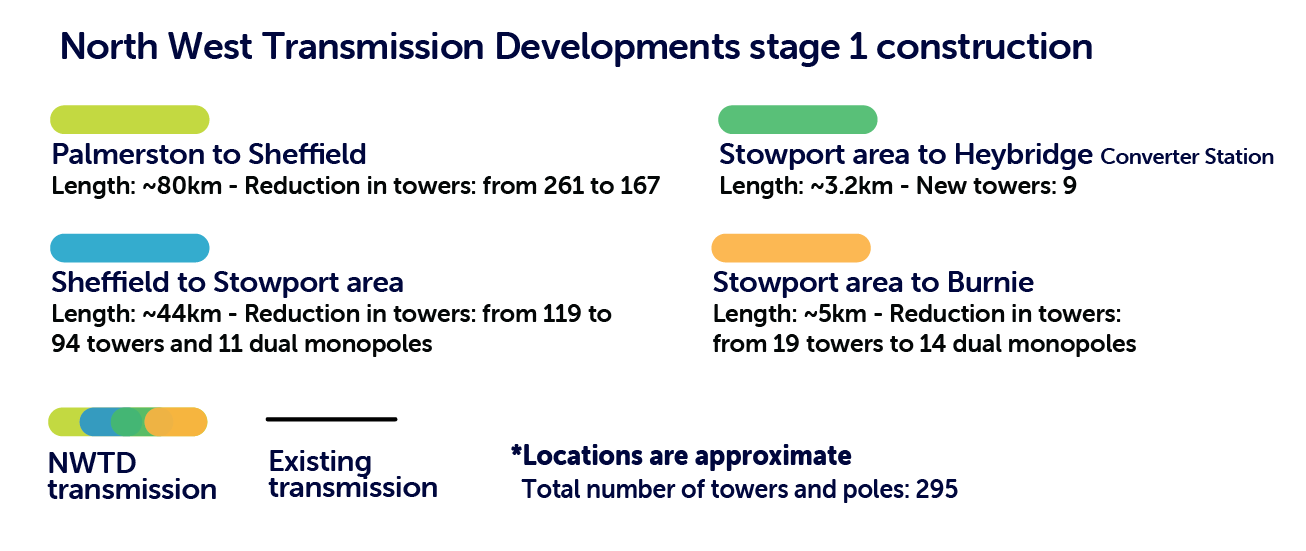
New and upgraded transmission infrastructure
-
Palmerston to Sheffield upgrade
Read more
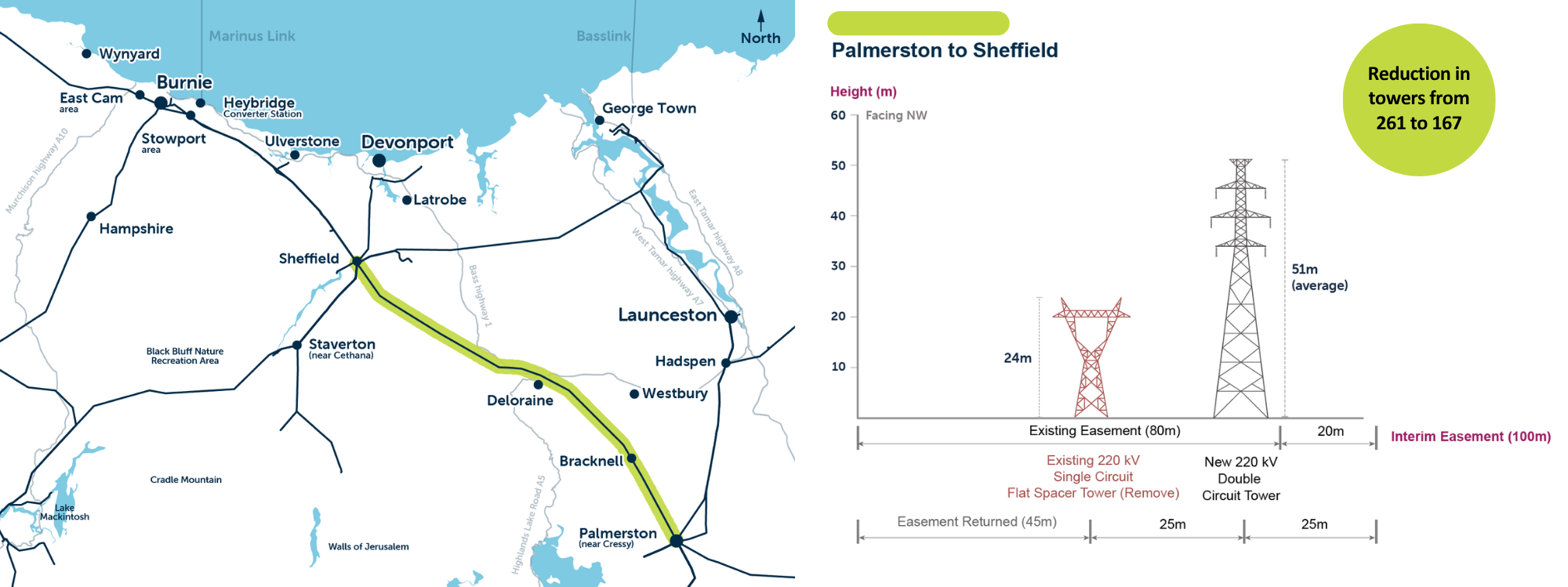 Between Palmerston and Sheffield, a double circuit 220 kilovolt (kV) transmission line will be constructed alongside the existing transmission line on its north eastern side. To accommodate the line, the existing easement will need to be widened by around 20 m during construction. TasNetworks has committed to returning any redundant easement to landholders once construction is complete. The line is around 80 km long with 167 new towers at an average height of 51 m.
-
Sheffield to Stowport area upgrade
Read more
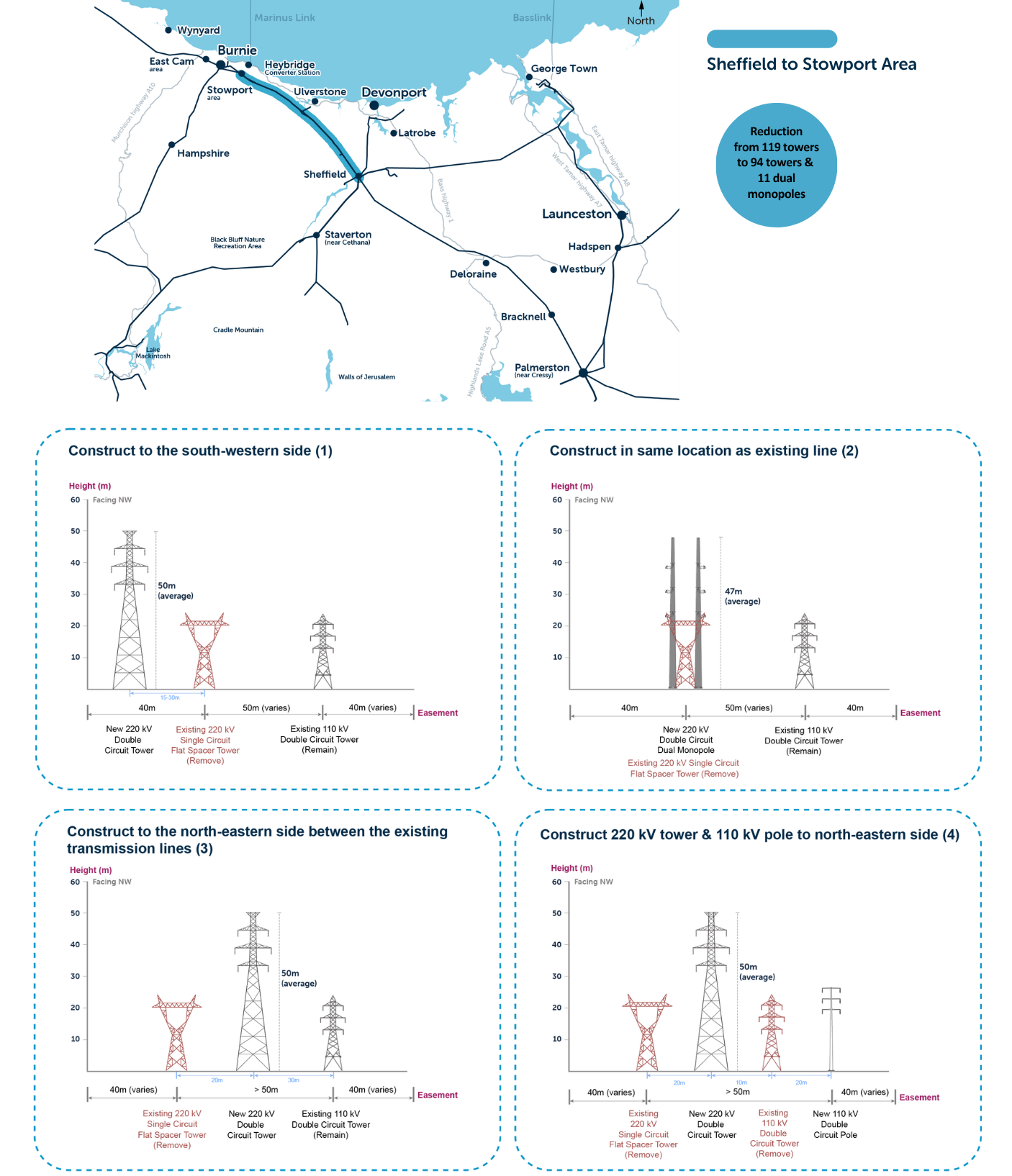 The section between Sheffield and the Stowport area is the most complex construction zone of the NWTD project. Upgrading critical transmission infrastructure in this highly constrained corridor while maintaining reliable power to customers requires significant planning, coordination and careful staging of works.
For this section, a double circuit 220 kV transmission line will be constructed mostly on the south‑western side next to the existing single circuit 220 kV line which will then be removed (1). To make room for the line to be built on the south‑western side, the easement will need to be widened by around 20 m.
In some locations, the upgraded line will be built in the same location as the existing line (2) or on the north eastern side (3)(4).
The line will be around 44 km long with 94 new towers at an average height of 51 m and 11 new dual monopoles at an average height of 28 m.
-
Stowport area to the Heybridge converter station
Read more
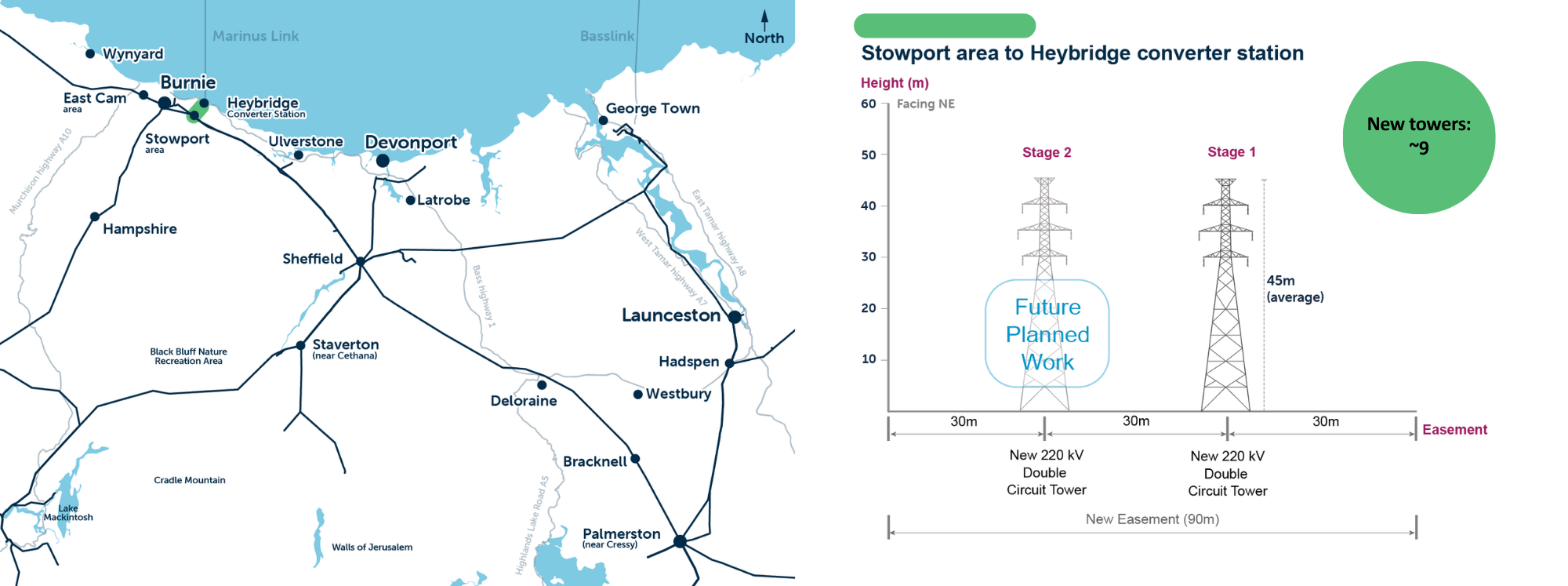 To connect Marinus Link, a new easement is needed along a 3.2 km section between Stowport and the Heybridge site that will host the Heybridge 220 kV switching station and Marinus Link converter station.
As part of Stage 1 of the project, one new 220 kV double circuit transmission line will be built. The line will sit within a 60 m wide easement with 9 new transmission towers.
This new line will carry electricity between Sheffield and the converter station, as well as to and from Burnie.
-
Stowport area to Burnie upgrade
Read more
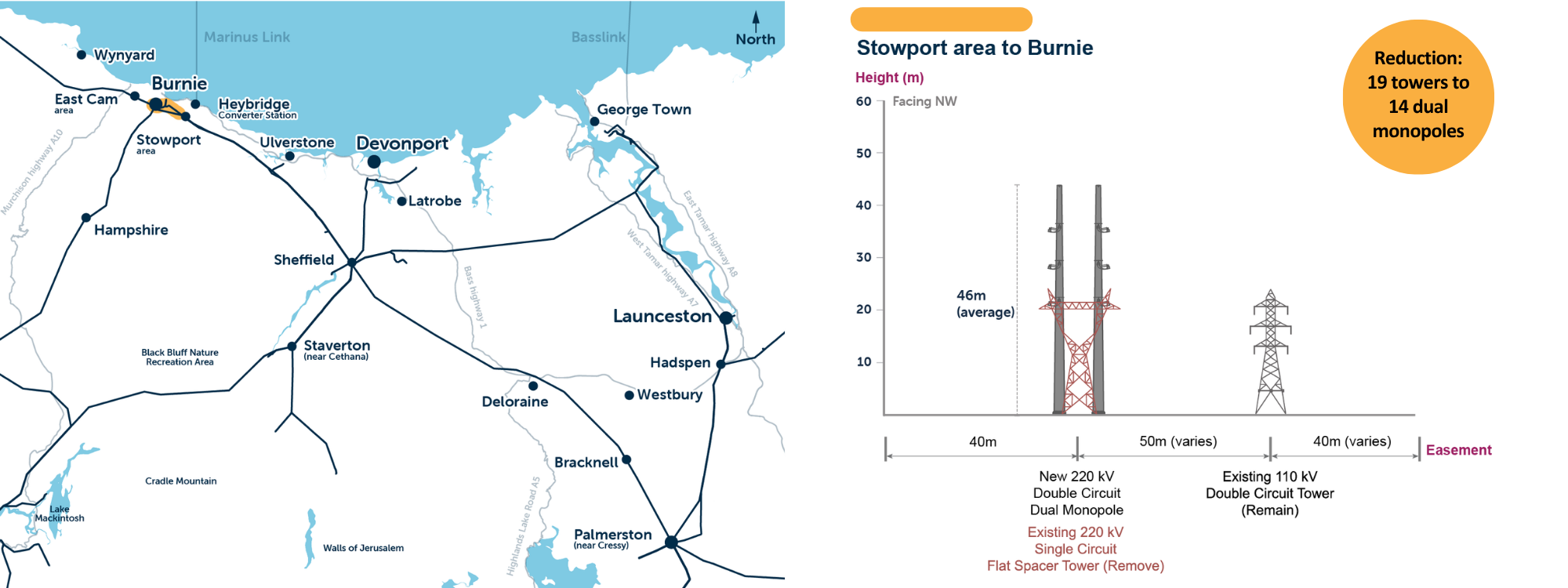 From near Minna Road, the existing transmission infrastructure will be replaced with a double circuit 220 kV transmission line. This section will be approximately 5 km in length with 14 new dual monopoles in total.
Transmission line construction steps
-
Step 1: Clearing and access
The first step of construction involves marking out the location of the towers and any areas of vegetation to be cleared to allow the transmission line to operate safely. Also, during this step, property access points are established and gravel tracks constructed to each tower site. Existing access points and tracks will be upgraded where possible to minimise impacts on properties. Where new access is required, the location of tracks is agreed with landholders before construction starts.
-
Step 2: Foundations
The ground is dug out using heavy machinery to prepare the foundations. In steep areas, the ground may need to be levelled out so the structure can be safely built.
-
Step 3: Tower assembly
The steel parts for each transmission tower are manufactured, coated to protect them from corrosion, sorted and packaged at an off-site facility. They are then transported to the tower location, usually by semi-trailer truck.
Once on site, the parts are put together into sections. A large mobile crane is then used to lift and position each section until the tower is fully erected.
-
Step 4: Conductor stringing
Installing the powerlines on the transmission towers is called conductor stringing. This stage uses specialised equipment and typically involves a helicopter or drone.
During this process, crews install both the powerline conductors and the optical ground wire (OPGW). The OPGW helps provide reliable telecommunications and protects the transmission line from lightning strikes.
A drone or helicopter is used to pull a lightweight draw wire between towers. This draw wire is then used to pull the conductors into place. Winches and braking equipment are used to control the wires and keep the correct tension as they are installed between towers.
-
Step 5: Decommissioning old structures
With construction of the new transmission line complete, any old infrastructure is removed. Depending on landholder agreements, foundation structures may be removed or reduced below ground level and covered to allow the land to be rehabilitated.
-
Step 6: Site rehabilitation
Once the powerlines have been installed, temporary work areas are rehabilitated and access tracks are removed, where agreed with the landholder. This rehabilitation work helps the land recover by encouraging vegetation to regrow and reducing the risk of soil erosion.
-
Step 7: Operation and maintenance
It is TasNetworks’ role to energise, operate and maintain the transmission infrastructure once construction is complete and commissioned. For the operation and maintenance phase, the amount of activity onsite decreases dramatically.
TasNetworks' maintenance teams will conduct periodic inspections of the line, towers, easement vegetation and access tracks in accordance with standard schedules and procedures.
This is typically done once or twice per year using light vehicles and sometimes helicopters and drones.
New and upgraded substation infrastructure
-
New Heybridge switching station
The Heybridge switching station will be a new addition to the network. It will serve as the Tasmanian connection point for Marinus Link. To minimise its physical footprint, the switching station will use gas‑insulated switchgear (GIS) technology. It will be built next to the Marinus Link converter station, and both will be located at the site known locally as the old Tioxide factory. This was a significant industrial site that operated for several decades, primarily producing titanium dioxide. The switching station will connect into Tasmania’s electricity network via a new 3.2 km overhead transmission line branching from the Sheffield–Burnie 220 kV transmission line.
-
Sheffield substation
Read more
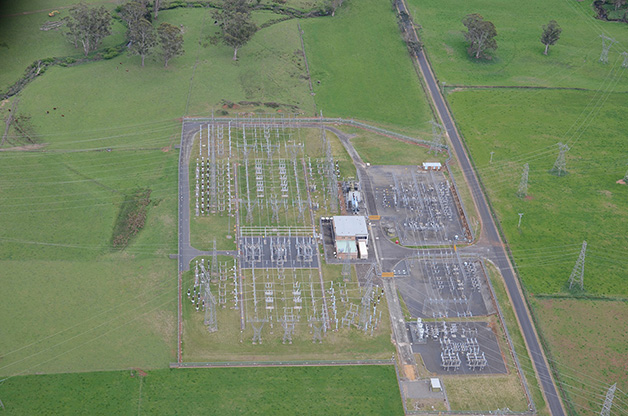 The Sheffield substation is an important part of Tasmania’s electricity network. It helps move electricity between the west coast, north‑west Tasmania, and George Town. This supports major industries and the Basslink connection to the mainland. To connect Marinus Link and meet the growing demand for electricity in the region, the substation needs major upgrades to ensure it can continue to operate safely and reliably.
The site will be enlarged to make room for two 220 kV overhead transmission lines:- Palmerston to Sheffield
- Sheffield to Heybridge and Burnie
-
Burnie substation
Read more
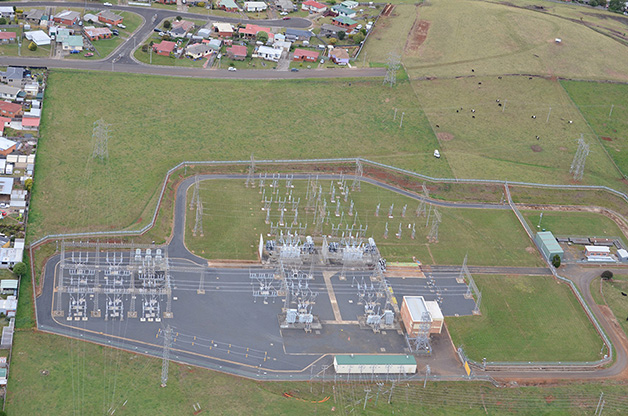 The Burnie substation is responsible for power flow between the north‑west and far‑north‑west regions of Tasmania, including residential, major industrial customers, and wind energy generators. The Burnie substation will be upgraded to accommodate the 220 kV transmission line from Sheffield to Heybridge and Burnie. New electrical switching and control equipment will be installed to increase the performance and reliability of the north‑west network. The upgrade will fit within the existing footprint of the substation.
-
Palmerston substation
Read more
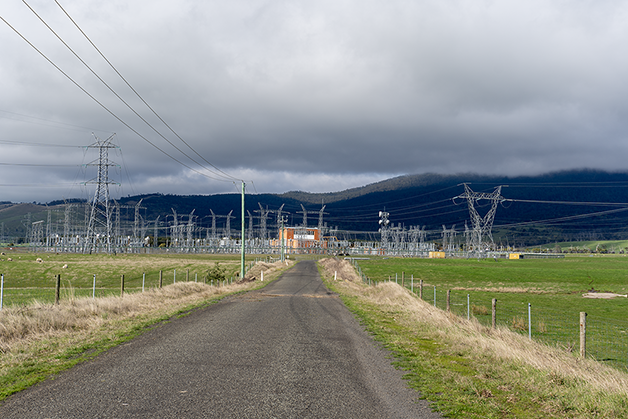 The Palmerston substation helps move electricity between the north and south of the state and connects the Poatina hydroelectric power station to the network. New equipment will be installed to accommodate the 220 kV transmission line from Palmerston to Sheffield. Additionally, protection and control equipment within the substation will be enhanced and upgraded. The overall footprint will remain unchanged, with the upgrade using existing space within the substation.
Substation construction steps
-
Step 1: Site establishment and bulk civil works
Before any electrical work begins, each site must be prepared. This stage is the most visible from outside the fence of the substation and involves the most vehicle movements. Work in this stage may include vegetation clearing or bulk earthworks to create stable building pads, site fencing and drainage works.
At Burnie, Sheffield and Palmerston, this work happens alongside the operating substations, so it is carefully planned to keep the power on while construction proceeds.
-
Step 2: Foundations and underground services
With the ground prepared, work shifts below the surface. Concrete foundations are poured for buildings, steel structures and heavy electrical equipment, while trenches are excavated for underground services such as protection, communications and power. An earthing grid is installed to safely manage faults or lightning strikes and help protection systems detect issues quickly. Conduits and cable trenches are also laid to form the pathways for future cabling. During this stage, concrete trucks and excavators are common to see on-site.
-
Step 3: Structures and supporting steelwork
Steel structures are then erected on the completed foundations. These include the frameworks that support electrical equipment, overhead conductors and lightning protection. Cranes will be visible on site as steelwork and building elements are lifted into place.
-
Step 4: Installing the primary switchgear
This is when the substation works start to take shape as recognisable electrical infrastructure. The major high-voltage equipment - known as primary switchgear - is delivered and installed. Some of this equipment is large and arrives on oversized vehicles, so occasional traffic management may be in place around delivery days.
-
Step 5: Conductors and cabling
With the equipment in place, everything is connected. This involves two distinct systems:
- Primary systems are the large conductors and equipment that carry the electrical power used in our communities and industry. They are the visible overhead conductors and heavy connections between equipment.
- Secondary systems are the substation’s view into how the primary system is operating, and if a fault occurs, provide the action to isolate it safely. This is the small wiring and cabling that runs protection, control, and remote monitoring that lets TasNetworks operators supervise the substation from the control centre. These systems constantly watch the network and automatically respond within fractions of a second if something goes wrong.
-
Step 6: Testing and commissioning
Before any new equipment is connected to the live network, every system is thoroughly tested. Commissioning is the structured process of proving that each piece of equipment, and the substation in its entirety, works exactly as designed. This stage involves specialist technicians and can take several months, though it generates far less noise and traffic than earlier stages.
-
Step 7: Operation and maintenance
Once testing is complete, the substation is energised, connected to the transmission network and brought into service in a carefully controlled sequence. Finally, the site is tidied and reinstated.


Information Hub
Explore the Information Hub for NWTD fact sheets, reports and key project information
