



Meeting Network Planning Requirements at George Town
Overview
George Town substation is the sole substation supplying the George Town area in the northeast of Tasmania. It is the connection point for Basslink, the interconnector which links the Tasmanian and Victorian electricity networks. It also supplies transmission connected customers at Bell Bay, a major industrial area in Tasmania.
The Australian and Tasmanian Governments have agreed to develop Bell Bay as one of Australia’s first Hydrogen Hubs. This follows the Tasmanian Government publishing the Tasmanian Renewable Hydrogen Action Plan in 2020 that envisions Tasmania as a major producer and exporter of hydrogen by 2030. In response, TasNetworks received a number of connection enquires from proponents seeking to establish hydrogen production facilities in Bell Bay, supplied out of the George Town substation. TasNetworks has similarly received interest from other large load proponents, including data centres.
Our role
TasNetworks is resolute in its commitment to power system performance and security which underpins the delivery of safe and reliable services for our customers.
As Tasmania’s transmission network service provider, when planning Tasmania’s power system we are required to comply with the minimum network performance requirements outlined in the Electricity Supply Industry (Network Planning Requirements) Regulations 2018. We are also required to comply with network operation requirements outlined in the National Electricity Rules (NER).
As new load connects at George Town, management of voltage stability is necessary to ensure secure operation of the power system. Specifically, the NER requires that the reactive margin must not be less than one per cent of the maximum fault level at the connection point.
Under existing operating conditions, to ensure compliance with the NER, a constraint is applied to Basslink export to maintain acceptable voltage stability at George Town. However, following the connection of sufficient new load, without intervention, these constraints will severely limit Basslink export and may not fully mitigate voltage stability issues (including the risk of a black system) under all operating conditions.
Following the connection of sufficient new load, additional reactive power support is required to avoid non compliance with the NER and network planning requirements.
TasNetworks is applying the Regulatory Investment Test for Transmission (RIT-T) process to determine which investment should be pursued to meet NER and network planning requirements, following the commitment of ≥210 MW of new load to connect at the George Town substation.
The Regulatory Investment Test for Transmission (RIT-T) Process
The RIT-T is designed to help identify the most appropriate future investment(s) needed to meet our network planning requirements in George Town, while ensuring that costs borne by network users are transparent and justifiable.
As part of this process, three main documents will be produced and consulted on:
- The Project Specification Consultation Report (PSCR) describes the need for investment, potential credible options to address the identified need, and technical information to encourage solutions from non-network proponents.
- The Project Assessment Draft Report (PADR) describes the results of the cost benefit analysis, identifies the preferred option and provides a summary of, and responds to, submissions received to the PSCR.
- The Project Assessment Conclusion Report (PACR) confirms the preferred option and provides a summary of, and responds to, submissions received to the PADR.
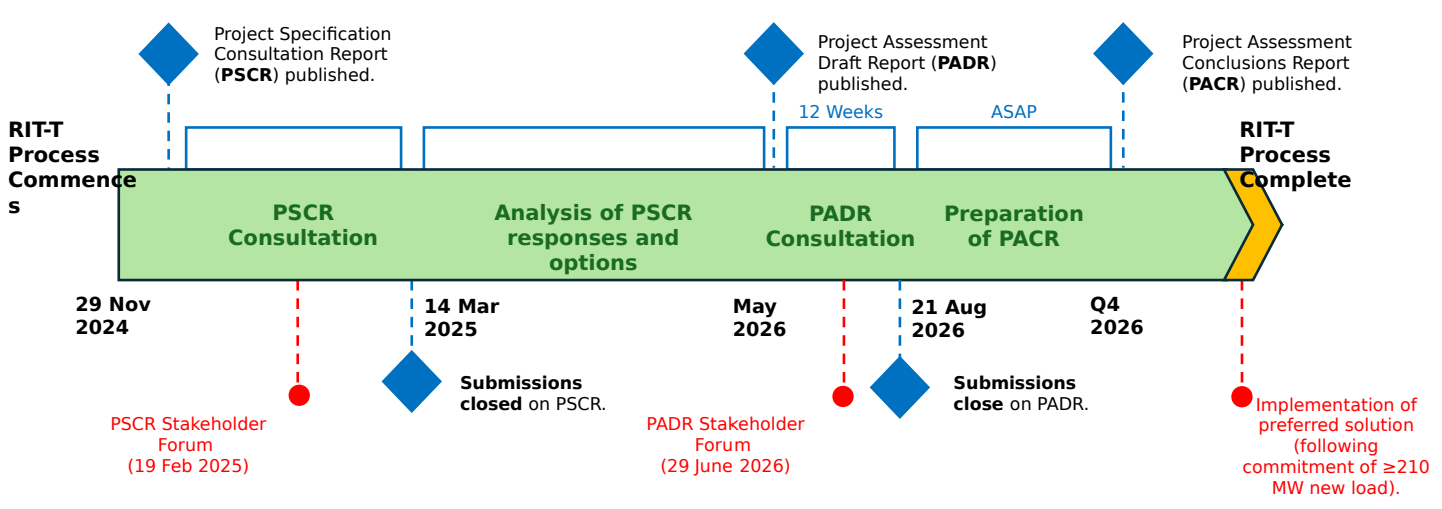
The anticipated sequence of events for the RIT-T is shown below.
Consultation
Project Assessment Draft Report
Following publication of the PSCR in November 2024, we are now seeking feedback on the draft economic assessment presented in the PADR. We also remain interested in hearing from any non-network service providers capable of helping us meet our NER and network planning requirements to ensure we identify the most technically efficient and cost effective outcome for our customers.
At this draft assessment stage, we have identified one credible network option (which was identified as a contingent project in our revenue proposal for the 2024‑2029 regulatory control period) at a cost of $370.6 million. The option involves:
- establishment of a new air insulated switchgear substation;
- installation of 550 Megavolt-Ampere reactive (MVAr) of reactive support in the new substation; and
- reconfiguration of the 220 kilovolt (kV) switchyard at the existing George Town substation.
The draft economic assessment indicates that in weighted net present value terms, delivery of this credible network option to maintain voltage stability and ensure compliance with NER and network planning requirements following the connection of new load at George Town is expected to deliver $234 million in net market benefits.
On 29 June 2026, we hosted a public stakeholder forum to provide interested stakeholders with an update on this RIT-T. In the forum we explained the need for future network investment, presented the preferred solution identified in the PADR, shared our draft economic assessment and highlighted our interest in receiving any stakeholder feedback on the PADR.
A copy of the presentation we shared and a summary of the forum can be found below.
- Meeting Network Planning Requirements at George Town PADR – Public Stakeholder Forum – Presentation
- Meeting Network Planning Requirements at George Town PADR – Public Stakeholder Forum – Summary
Key Dates
TasNetworks is seeking feedback the PADR over a 12 week period ending at COB Friday 21 August 2026.
Submissions in relation to the PADR can be sent directly to: regulation@tasnetworks.com.au.
A copy of the PADR can be found below.
For further information, please contact: Matthew Clarke (Leader Large Regulated Investment) at regulation@tasnetworks.com.au.
Next Steps
We intend to publish a PACR as soon as practicable after the end of the PADR consultation period.
The PACR must include the matters set out in the PADR and a summary of, and our response to, any submissions received to the PADR.
The PACR will complete this RIT-T process. We will then deliver the preferred option following the commitment of ≥210 MW of new load at George Town and the Australian Energy Regulator’s approval of prudent and efficient expenditure proposed through a Contingent Project Application.
Further information
TasNetworks is currently undertaking several other RIT-T projects. Further information on these projects can be found on our Regulatory investment test projects page.